Looking Back To...
Radio and Television
By
Roger Turner
| 
| I was telling me dad about these new super-wide digital crystal plasma liquid TV's the other day and telling him about all the new functions and dozens of free channels he can watch. But after a while, I realized that he had fallen asleep.
Now I am of the generation that grew up with ever-changing, state-of-the-art, technology, and have seen many changes, but my dad grew up in an age where technology was treated with suspicion.
Back in the 50's (yawn) when I was a lad, every house had a wireless set. If we wanted to listen to Children's Hour at 5pm, the set would be plugged in and switched on a few minutes early to allow for the old valves to warm up. Then the thing would suddenly crackle into life and the dial on the front would be very carefully twisted with much hiss, bypassing many foreign stations that littered the airwaves. After much cursing and cussing by us, the BBC Home Service announcer would proudly declare in that stiff upper lip voice of his that the Adventures in Toy Town would commence immediately.
| 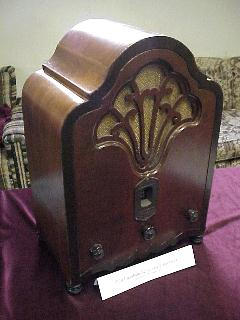
| We kids would sit in silence while Uncle Mac came on with the squeaky voice of Larry the Lamb to keep us enthralled for half an hour in this magical land.
Once Children's Hour was over the wireless was turned off to save the precious valves.
But it was not just mains powered radios, for some people still lived in homes without electricity, and they had great big heavy batteries that needed taking to a radio shop to be charged up. I suppose these were the forerunner of the portable radios that came in with the transistor revolution of the late 50s and early 60's. Mind you, you needed to spend well over 20 quid to buy some of the first truly portable radios that were about way back then.
| 
| My dad, on the other hand, grew up in the pre-radio days, and can remember when the very first crystal sets were the 20s equivalent of the new DAB radio sets. In fact, I can just remember my grandfather showing me an old crystal set when I was very young. Wow, I wish I had it now, it would be worth a fortune. | 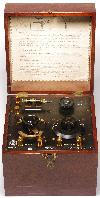
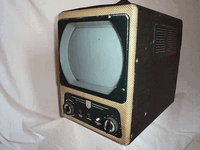
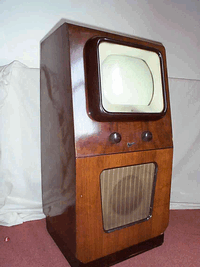
| Nowadays we all take TV's for granted, and many of us will dump a perfectly good set and spend silly money on the latest fad. But back in the 50s, TV's were a rarity. The first time I saw one was back home in Sheffield in early 50s when the Queens coronation was shown. It was a huge set with a massive 10 inch screen in glorious grainy black and white. About a dozen families were crushed into the front room of a house up the road and we kids were sat cross legged and mesmerised (another word for bored) while the camera showed the procession through the rain-lashed streets of London.
| 
| The best thing was the feast we had: potted beef sandwiches, sausage rolls, fairy buns, junket and blancmange, with lashings of Dandelion & Burdock and Tizer.
Back in the good old days of the 50s, there was no 24-hour TV like we get now, for the then Postmaster General dictated how many hours of television could be shown each week. In 1956, for example, the BBC was allowed to broadcast television on weekdays between 9am and 11pm, but with a break between 6pm and 7pm when no television was broadcast.
This period was used by parents to try and trick us children into thinking that the evening's television had finished so we would go to bed without moaning (fat chance, we were not as daft as they thought!) - it was known way back then as the 'toddlers' truce' . Imagine that happening today! The 'toddlers' truce' was dropped in 1957.
Anyway, back in Sheffield, not many people around us could afford to buy a television outright, let alone manage the cost of a TV licence. And it was the same in Balbriggan in the 50s, with one exception, those who could afford a TV did not have buy a licence, for situated where you were, the signal came down from the north, and residents of the town could watch English TV for free.
Every summer when I came over, more and more houses were displaying the badge of affluence in the form of the TV aerial. True, the sets were still large and with tiny screens and by today's standards the picture quality was poor, the programmes crude and hammy, but to us kids they opened up a new and exciting world.
| Anyway, back in Sheffield, not many people around us could afford to buy a television outright, let alone manage the cost of a TV licence. And it was the same in Balbriggan in the 50s, with one exception, those who could afford a TV did not have buy a licence, for situated where you were, the signal came down from the north, and residents of the town could watch English TV for free.
Every summer when I came over, more and more houses were displaying the badge of affluence in the form of the TV aerial. True, the sets were still large and with tiny screens and by today's standards the picture quality was poor, the programmes crude and hammy, but to us kids they opened up a new and exciting world.
But breakdowns were commonplace so a kid was dispatched to the TV shop to invite the repair man to call round. Eventually a funny little fella in the long brown coat, would pull up outside in his old green van and head indoors with his tool box plus a box of expensive and delicate valves to effect the necessary repair. I think its true to say that back then most TVs were rented or bought on the never-never. Mind you, before you called out the repair man, the first course of action was to give the top of the set an almighty thump and if that failed, a couple on the side sometimes shocked it back into life.
In most towns and cities small companies grew up just to sell and service the new televisions sets that were now coming on to the market. Some specialised on outright sales, while many others encouraged you to rent, and many national chains developed to fill all needs.
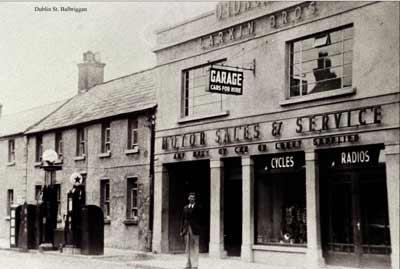
Now I have been wracking my brain to remember the name of the shop in Balbriggan where you got your TV from, and the name "Larkins" comes to mind and they were on the Dublin Road. So come on! Help me out as there must have been more than one in Balbriggan back in the 50s.
| Anyway, that grainy black and white world we children of the 50s escaped into was a magical world. And somehow when colour came in the 60s and the multi-channel technical revolution burst onto the unsuspecting public, life was just not the same, for some of the magic had gone.
To be Continued.........
| 
Cor..... Where did that come from? |
|
 |
|
|
|


